Author: admin

  • Bitcoin Survival Guide: Soft Fork or Die

    Bitcoin is often called “digital gold” because it is immutable. It doesnt change easily. That feature is its greatest strength, but in the face of the quantum threat, it could be its fatal flaw.

    The P2PK Vulnerability

    Old Bitcoin addresses (Pay-to-Public-Key or P2PK), including those mined by Satoshi Nakamoto in 2009, expose their raw public keys to the blockchain. This makes them the easiest targets for Shors Algorithm. Newer addresses (P2PKH) hash the public key, adding a layer of protection—but only until you send a transaction.
    Bitcoin Shield against Laser
    Bitcoin must upgrade its cryptographic armor to survive the quantum age (Image: Generated by Imagen 3).

    The Soft Fork Solution

    To survive, Bitcoin developers must implement a Soft Fork that introduces a new, quantum-safe signature scheme (like Lamport signatures or STARKs). Users would then have to move their coins to new, secure addresses.

    The problem is the “Lost Coins.” Millions of BTC havent moved in over a decade. If the network upgrades, what happens to the old, vulnerable addresses? Do we burn them? Do we let hackers loot them? This will likely be the biggest governance crisis in Bitcoins history.

    Sources: Bitcoin Optech, Deloitte Analysis.

  • How to Rent a Quantum Computer Today (Amazon Braket)

    You cannot buy a quantum computer. They cost millions of dollars and require a team of PhDs to maintain. But you can rent one by the second, just like you rent a server on AWS.

    Quantum as a Service (QaaS)

    Amazon Braket, IBM Quantum Experience, and Microsoft Azure Quantum are democratization engines. They allow anyone with a laptop and a credit card to write Python code (using SDKs like Qiskit or Cirq) and send it to a real quantum processor.

    Cloud Computing Quantum
    The cloud is getting a quantum upgrade. Access D-Wave, IonQ, and Rigetti from your browser (Image: Generated by Imagen 3).

    Hybrid Workflows

    The future isnt purely quantum. It is hybrid. In a typical workflow, a classical computer handles the data preprocessing and the user interface, while the heavy optimization or simulation task is offloaded to the QPU (Quantum Processing Unit) in the cloud. The results are then returned to the classical server.

    This model means that companies dont need to build their own quantum labs; they just need to build quantum-ready software.

    Sources: Amazon Braket, IBM Quantum Platform.

  • Quantum Biology: Is Your Brain a Quantum Computer?

    For decades, physicists assumed that quantum effects could only exist in a vacuum at absolute zero temperature. They believed that the warm, wet, and messy environment of the human body would destroy any quantum state instantly (decoherence).

    The Microtubule Theory

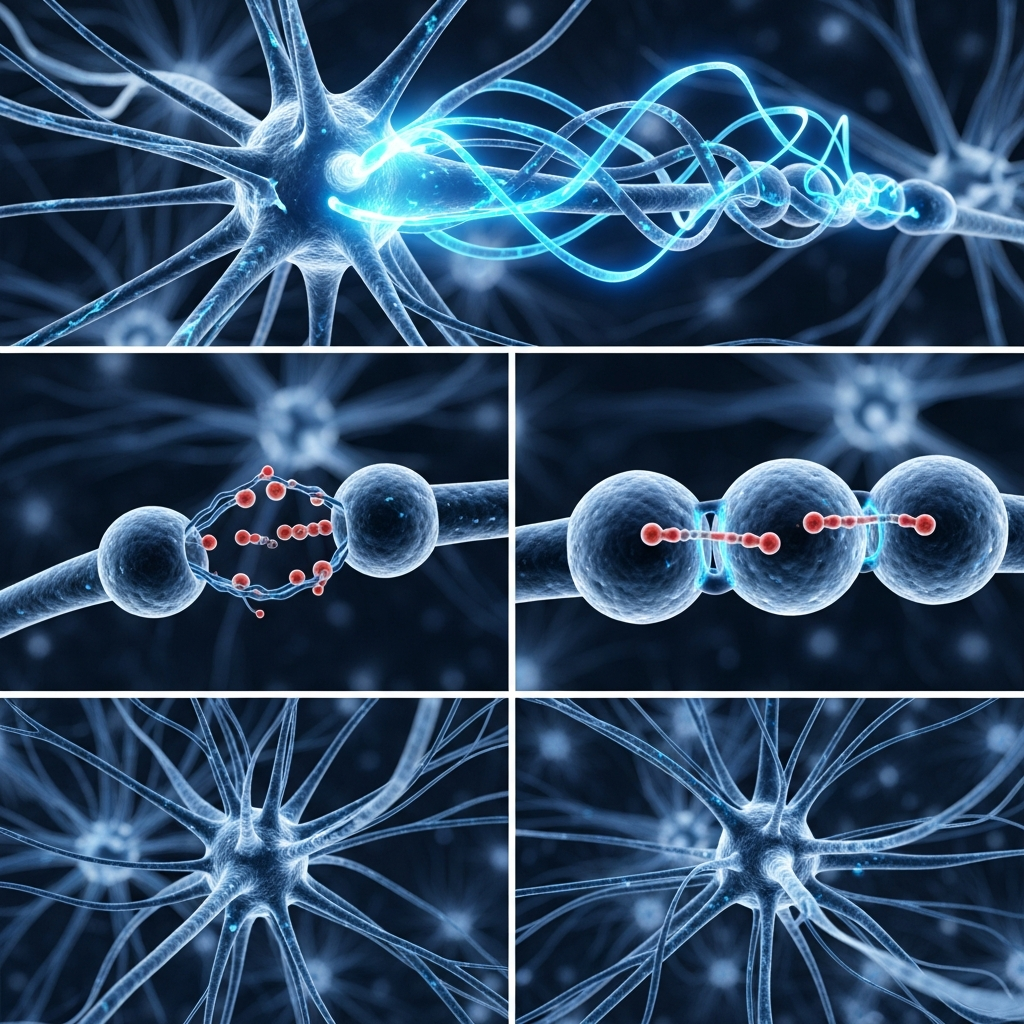
    Physicist Sir Roger Penrose and anesthesiologist Stuart Hameroff have a controversial theory called Orch-OR (Orchestrated Objective Reduction). They argue that consciousness originates from quantum vibrations inside microtubules—tiny protein structures within our brains neurons.

    Neuron firing with quantum energy
    Could the human brain be a biological quantum processor? (Image: Generated by Imagen 3).

    Photosynthesis and Navigation

    While the consciousness theory is debated, quantum biology is already proven in other areas. We know that plants use quantum coherence to transfer sunlight energy with near 100% efficiency during photosynthesis. Similarly, European Robins use quantum entanglement in their eyes to see the Earths magnetic field for migration.

    If nature has been using quantum tech for millions of years, can we reverse-engineer it to build better organic computers?

    Sources: Penrose & Hameroff Review, Physics World.

  • Quantum Teleportation: Debunking the Star Trek Myth

    “Beam me up, Scotty.” It is the most famous phrase in science fiction. And when scientists announced they had successfully “teleported” a photon from the ground to a satellite in orbit, the world went wild. Are we about to start commuting by teleportation?

    Not Matter, But Information

    The short answer is no. Quantum Teleportation does not move matter. It moves quantum states. It destroys the state of a particle in one location and instantly recreates an identical state on a particle in another location, using the phenomenon of Quantum Entanglement.

    Quantum Teleportation Beam
    We arent moving people, we are moving the blueprints of reality (Image: Generated by Imagen 3).

    The Unhackable Internet

    While it wont save you a trip to the airport, this technology is revolutionary for the internet. It allows us to send information between two points without it ever traveling through the space in between. This means it cannot be intercepted. If someone tries to look at the data while its being teleported, the entanglement breaks and the message destroys itself.

    This is the foundation of the future Quantum Internet—a network that is physically guaranteed to be secure by the laws of the universe.

    Sources: NASA Science, Caltech News.

  • The “Noise” Problem: Why 1,000 Qubits is a Lie

    Open any tech news site, and you will see headlines like “IBM Unveils 1,000 Qubit Chip.” It sounds impressive. It implies we are 1,000 times closer to breaking encryption. The reality is much messier.

    Physical vs. Logical Qubits

    Quantum states are incredibly delicate. A stray photon, a vibration from a passing truck, or a fluctuation in temperature can cause a qubit to lose its memory (decoherence). This is called “noise.”

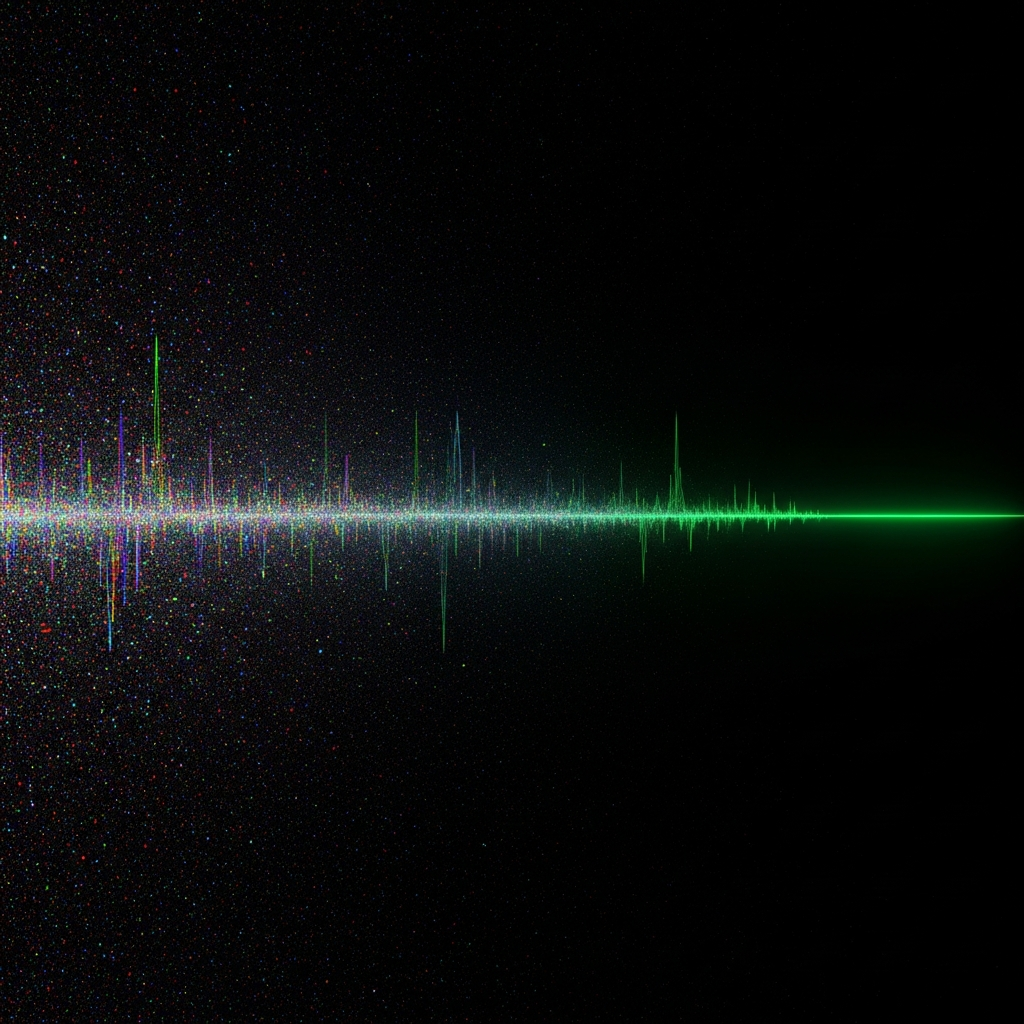
    Signal noise to clean line
    We need to turn the chaotic noise of physical qubits into the clean signal of logical qubits (Image: Generated by Imagen 3).

    To do useful work, we need Logical Qubits—qubits that never make a mistake. To create ONE logical qubit, we might need to gang together 1,000 noisy physical qubits using Quantum Error Correction code. The majority of the computers power is spent just checking itself for errors.

    The Real Metric

    So when a company says they have a 1,000-qubit processor, ask them: “Are those physical or logical?” Today, we have zero logical qubits. The race isnt just to build more qubits; its to build better ones.

    Sources: IEEE Spectrum, Surface Code Research.

  • Hardware Wars: Superconducting vs. Trapped Ions

    Just as VHS fought Betamax and iOS fights Android, the quantum world is split into two warring factions. On one side, we have the Superconducting Qubits, championed by tech giants like Google and IBM. On the other, Trapped Ions, backed by IonQ and Honeywell.

    Team Superconductor (The Golden Chandeliers)

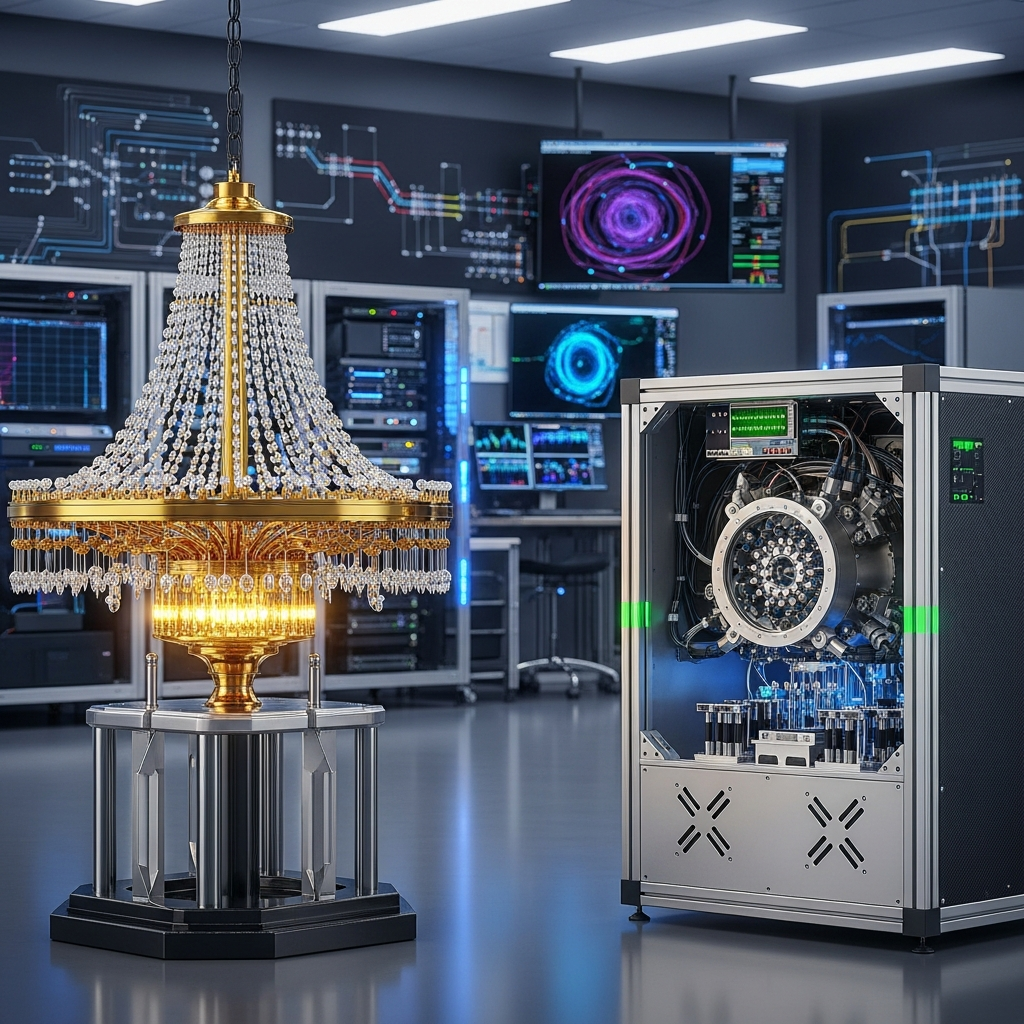
    If you have seen a photo of a quantum computer, you have probably seen a golden chandelier. This is a dilution refrigerator that cools the chip down to near absolute zero. These chips are fast—calculations happen in nanoseconds.

    Hardware Wars: Chandelier vs Laser
    Two very different approaches to building the ultimate machine (Image: Generated by Imagen 3).

    However, they are fragile. The qubits (made of artificial atoms) interfere with each other easily, leading to errors. They are also hard to wire up as the chip gets bigger.

    Team Trapped Ion (The Laser Masters)

    IonQ uses a different approach. They take individual atoms (like Ytterbium), levitate them in a vacuum using electromagnetic fields, and hit them with lasers. Because these are natural atoms, they are identical and perfect by nature.

    Trapped ions have much lower error rates and better connectivity (every qubit can talk to every other qubit). The downside? They are slow. Operations take microseconds instead of nanoseconds.

    Who Wins?

    It is too early to call. Superconductors are currently leading in raw qubit count, but Trapped Ions are winning on quality (Quantum Volume). And lurking in the background are dark horses like Photonic (PsiQuantum) and Neutral Atom (QuEra) computers.

    Sources: IonQ Technology, Google Quantum AI.

  • Quantum Batteries: Charging EVs in Seconds, Not Hours

    Imagine charging your Tesla in 3 seconds. Not 30 minutes. Three seconds. Imagine a phone battery that lasts a month. This sounds like vaporware, but according to the laws of quantum mechanics, it is theoretically possible.

    The bottleneck of the electric vehicle revolution isn’t the motor or the software; it’s the chemistry. Lithium-ion batteries are heavy, slow to charge, and prone to catching fire. We are hitting the limits of what classical chemistry can achieve.

    The Simulation Game

    The problem is that we can’t see what’s happening inside a battery at the atomic level. Simulating the interaction of ions moving through an electrolyte is too complex for even the biggest supercomputer.

    Futuristic Quantum Battery
    Quantum simulations could unlock solid-state batteries with 10x energy density (Image: Generated by Imagen 3).

    This is the “Killer App” for quantum computers. Companies like Mercedes-Benz and IBM are already partnering to model new materials for solid-state batteries. By simulating the quantum states of molecules, they can discover new electrolytes that offer 10x energy density without ever mixing a chemical in a lab.

    Superabsorption: Breaking the Rules

    But it gets weirder. Researchers are exploring a quantum phenomenon called Superabsorption. In a classical battery, the more cells you have, the longer it takes to charge. In a quantum battery utilizing entanglement, the opposite happens: the charging speed increases with the size of the battery.

    This means a massive grid-scale battery could absorb energy almost instantly. We are years away from a prototype, but the physics suggests that our current charging speeds are just a temporary limitation of our primitive understanding of the universe.

  • Saving the Planet with Fertilizer: The Haber-Bosch Fix

    There is a paradox at the heart of modern agriculture. To sustain a population of 8 billion people, we rely on a chemical process that is shockingly inefficient. The Haber-Bosch process, invented in the early 20th century to synthesize ammonia for fertilizer, consumes nearly 2% of the world’s entire energy supply.

    It requires massive factories, immense pressure, and temperatures of 400 degrees Celsius to rip nitrogen bonds apart. Yet, just beneath our feet, soil bacteria do the exact same thing at room temperature, using no fossil fuels at all.

    The FeMoco Mystery

    The secret lies in an enzyme called Nitrogenase, and specifically in its catalytic core, a cluster of iron and molybdenum atoms known as FeMoco. For decades, chemists have tried to model this cluster to understand how it works, so we can replicate it industrially.

    Nature meets Quantum Tech
    Modeling Nitrogenase is the “Hello World” of quantum chemistry (Image: Generated by Imagen 3).

    They have failed. The electrons in the FeMoco cluster are highly entangled. Their spins interact in ways that cause the “many-body problem” to explode exponentially on a classical computer. Even a supercomputer the size of the earth could not accurately simulate the quantum state of this single molecule.

    The Holy Grail of Simulation

    This is why Microsoft’s Azure Quantum team has flagged Nitrogenase as a primary target. A quantum computer with just a few hundred logical qubits could map the electron orbitals of FeMoco perfectly.

    Solving this puzzle isn’t just about cheaper food. It is about decarbonization. Replacing Haber-Bosch with a bio-mimetic, room-temperature catalyst would slash global carbon emissions more effectively than almost any other single technology. It is a reminder that sometimes, the most advanced technology is simply catching up to what nature figured out billions of years ago.

  • The “Quantum Winter”: Is the Investment Bubble About to Burst?

    The free money party is over. For the last five years, pitching a “Quantum” startup to a Venture Capitalist was like printing money. It didn’t matter if you had a product. It didn’t matter if your roadmap violated the laws of physics. If you said “Qubit,” you got a check.

    Now, the hangover is setting in. Stock prices for public quantum companies like IonQ and Rigetti have seen massive volatility. The timeline for a commercially useful machine—one that can actually do something your MacBook can’t—keeps slipping from 2025 to 2030, and now to 2035.

    The Trough of Disillusionment

    We are entering what Gartner calls the “Trough of Disillusionment.” It happens to every hype cycle (remember 3D printing?). The early excitement fades as engineering reality hits. And the reality of quantum computing is brutal.

    Frozen computer chip
    Are investors getting cold feet as technical hurdles mount? (Image: Generated by Imagen 3).

    Keeping a qubit stable requires an environment colder than deep space, shielded from the magnetic field of the Earth, and isolated from a single stray photon. Building one is a triumph of physics. Building a million of them, wired together, is an engineering nightmare that we haven’t solved yet.

    Survival of the Fittest

    This “Winter” isn’t the end; it’s a filter. The companies with weak IP and flashy PowerPoints will die. The capital is consolidating around the serious players who are solving the hard problems—error correction and logical qubits.

    We saw the same thing happen to AI in the 1980s. The funding dried up for decades. But the people who kept working in the dark eventually gave us ChatGPT. The Quantum Winter is coming, but for those who can survive the cold, the spring will be revolutionary.

  • The Quantum Cold War: Why the US is Blocking Chip Exports to China

    The most significant trade war of the 21st century is not about steel or soybeans. It is about sub-atomic particles. In October 2022, the Bureau of Industry and Security (BIS) released a sweeping set of export controls. While the headlines focused on AI chips preventing China from training the next GPT-4, the fine print contained a lethal blow to Beijing’s quantum ambitions.

    The regulations specifically target the enabling hardware of quantum computing: dilution refrigerators that cool chips to near absolute zero, and advanced electronic control systems. This is the first time the US government has explicitly weaponized the supply chain of a technology that technically doesn’t even work yet.

    The Q-Day Nightmare Scenario

    Why the panic? Because in the eyes of the Pentagon, a fault-tolerant quantum computer is not a research tool; it is a weapon of mass decryption. The nation that reaches “Q-Day” first will possess the skeleton key to the world’s digital infrastructure. They could silently decrypt every intercepted military communication, intelligence cable, and grid schematic harvested over the last two decades.

    US vs China Quantum Race
    The next arms race isn’t nuclear; it’s computational (Image: Generated by Imagen 3).

    Asymmetric Warfare: Computing vs. Communication

    Interestingly, the two superpowers are betting on different horses. The US ecosystem (Google, IBM, Rigetti) is heavily focused on Quantum Computing—raw processing power. China, conversely, has poured billions into Quantum Communication.

    In 2016, China launched the Micius satellite, which successfully established a Quantum Key Distribution (QKD) link between space and Earth. This technology uses entangled photons to create a communications channel that is physically impossible to wiretap. If an eavesdropper attempts to observe the photons, the quantum state collapses, alerting the sender instantly.

    While the US tries to build a sword to break encryption, China is frantically building an unbreakable shield. The export bans are an attempt to freeze China’s sword-making capability while the US catches up on shields.