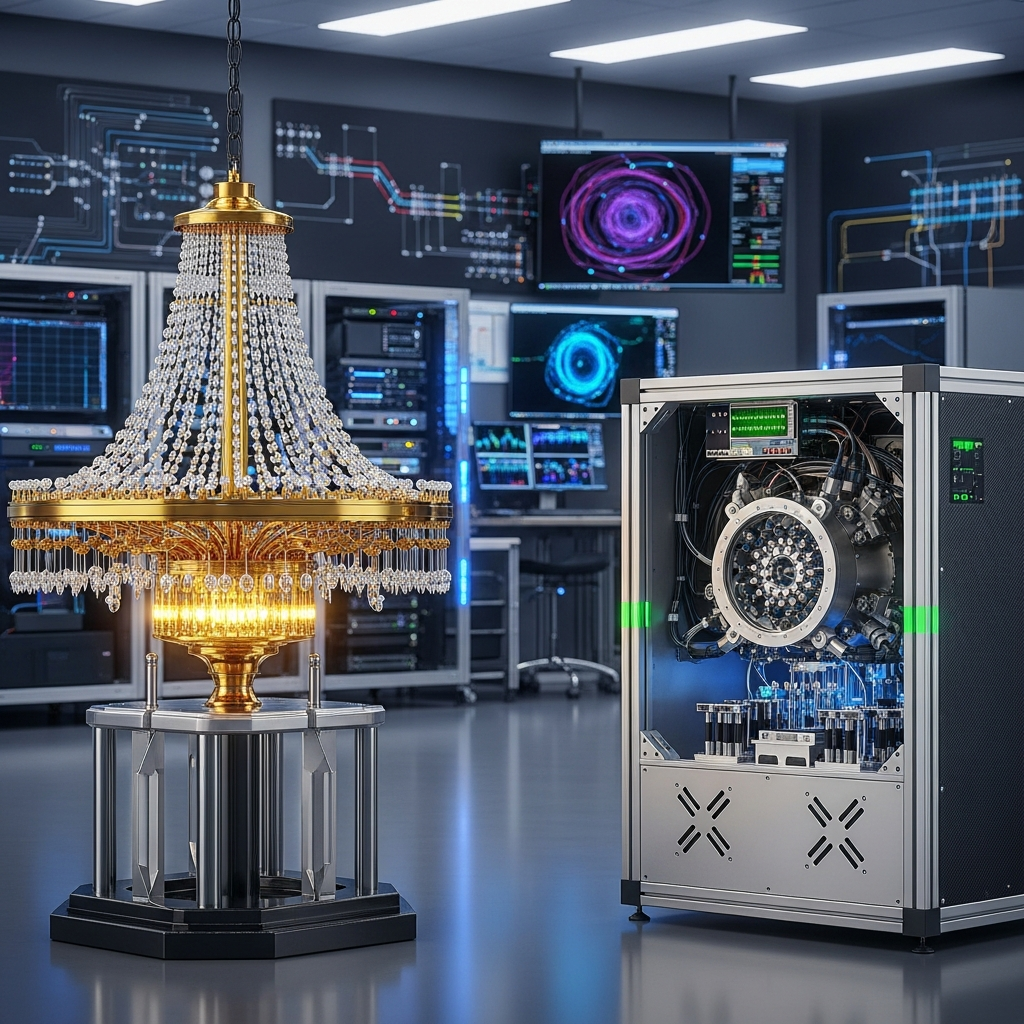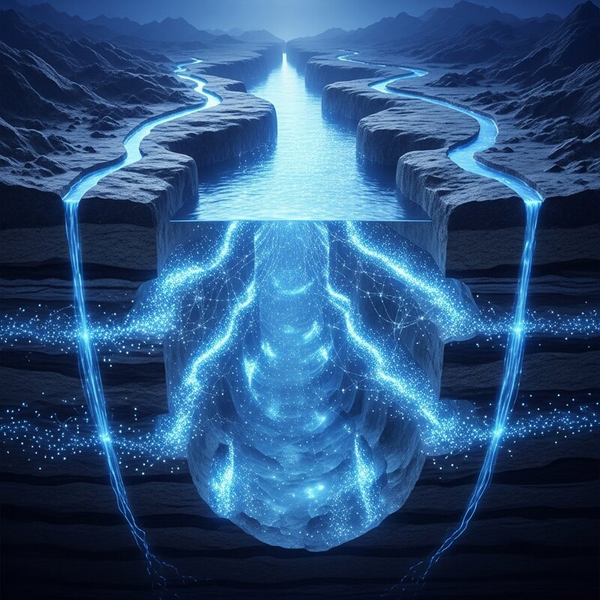
For centuries, finding water was the domain of the dowser—a solitary figure walking a field with a forked stick, waiting for the twitch that signaled a hidden spring. It was magic, or at least indistinguishable from it. Today, the stick has been replaced by a laser-cooled cloud of rubidium atoms, and the magic has been replaced by the rigorous, almost impossible precision of quantum mechanics.
We are standing on the precipice of a silent revolution in hydrology. While the world’s attention is fixed on quantum computers cracking encryption codes, a different breed of quantum device—the quantum gravimeter—is beginning to map the invisible oceans beneath our feet. For a planet facing an unprecedented water crisis, this technology might just be the most important application of quantum physics you’ve never heard of.
The Problem with Poking Holes
Traditionally, monitoring groundwater is a brute-force affair. You drill a well. You drop a sensor down the hole. You measure the water level at that single point. To understand an entire aquifer, you have to drill hundreds of these holes, a costly and invasive process that leaves hydrogeologists connecting the dots, guessing at what lies between the data points.
It’s like trying to understand the weather by looking out a single window. You miss the storms gathering just over the horizon. In California’s Central Valley, where aquifers are being drained faster than nature can replenish them, this lack of visibility is a disaster in slow motion. The ground is literally sinking—subsiding—as the water is pumped out, yet we still rely on 19th-century methods to track a 21st-century crisis.
Enter the Cold Atom
Quantum sensors, specifically cold-atom interferometers, offer a non-invasive alternative. The principle is deceptively simple: water is heavy. A large aquifer exerts a gravitational pull, however minute. As water is pumped out or replenished by rain, that mass changes, and so does the local gravity.
Classical gravimeters, often based on mechanical springs, have existed for decades. But they drift. They are sensitive to temperature, vibration, and time. They are finicky instruments better suited for a lab than a muddy field.
Quantum gravimeters work differently. They trap atoms in a vacuum using lasers, cooling them to nearly absolute zero until they behave more like waves than particles. By measuring how these matter-waves interfere with each other as they fall under gravity, these sensors can detect changes in gravitational acceleration with exquisite sensitivity—down to one part in a billion.
“It’s effectively a scale for the Earth,” says Dr. Elena Kogan, a researcher developing portable quantum sensors. “We can drive a truck over a field and ‘weigh’ the water underneath without ever breaking ground.”
From the Lab to the Land Rover
The challenge, as with all things quantum, has been moving the technology out of the cleanroom. Early quantum gravimeters were room-sized beasts requiring a phalanx of PhDs to operate. But the long tail of quantum development—the unsexy, iterative engineering work—is finally shrinking these devices down.
Companies in the UK and France are already field-testing quantum sensors on a truck. These ruggedized units can survey a farm in hours, producing a 3D map of water density. For a farmer deciding how much to irrigate, or a city planner monitoring for sinkholes, this data is gold.
The Civil Engineering of the Future
The implications extend beyond just finding water. We are talking about a fundamental shift in how we interact with the subsurface world.
- Construction: detecting voids or old mine shafts before a foundation is poured.
- Archeology: mapping buried structures without excavation.
- Volcanology: monitoring magma movement deep underground to predict eruptions.
But water remains the killer app. In regions like the Middle East or the American Southwest, water is becoming more valuable than oil. The ability to manage it with precision—to treat aquifers not as mysterious black boxes but as transparent reservoirs—is a geopolitical game-changer.
The Invisible made Visible
There is a poetic symmetry to it. We are using the smallest, most ethereal building blocks of the universe—atoms in a superposition—to measure its most vital, heavy resource. The dowser’s twitch has become an interference pattern, a ghostly ripple in a probability wave.
We are no longer guessing where the water is. We are watching it breathe.