“Beam me up, Scotty.” It is the most famous phrase in science fiction. And when scientists announced they had successfully “teleported” a photon from the ground to a satellite in orbit, the world went wild. Are we about to start commuting by teleportation?
Not Matter, But Information
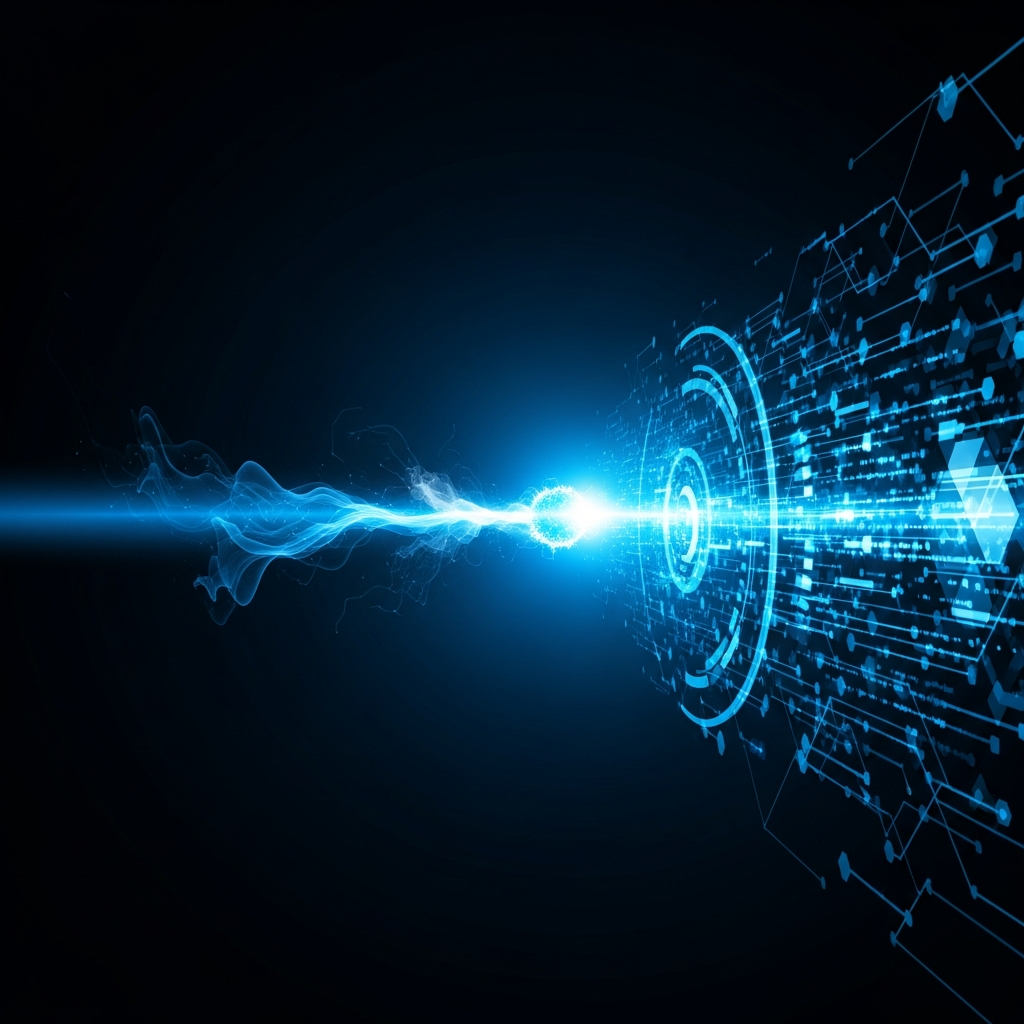
The short answer is no. Quantum Teleportation does not move matter. It moves quantum states. It destroys the state of a particle in one location and instantly recreates an identical state on a particle in another location, using the phenomenon of Quantum Entanglement.
We arent moving people, we are moving the blueprints of reality (Image: Generated by Imagen 3).
The Unhackable Internet
While it wont save you a trip to the airport, this technology is revolutionary for the internet. It allows us to send information between two points without it ever traveling through the space in between. This means it cannot be intercepted. If someone tries to look at the data while its being teleported, the entanglement breaks and the message destroys itself.
This is the foundation of the future Quantum Internet—a network that is physically guaranteed to be secure by the laws of the universe.
Open any tech news site, and you will see headlines like “IBM Unveils 1,000 Qubit Chip.” It sounds impressive. It implies we are 1,000 times closer to breaking encryption. The reality is much messier.
Physical vs. Logical Qubits
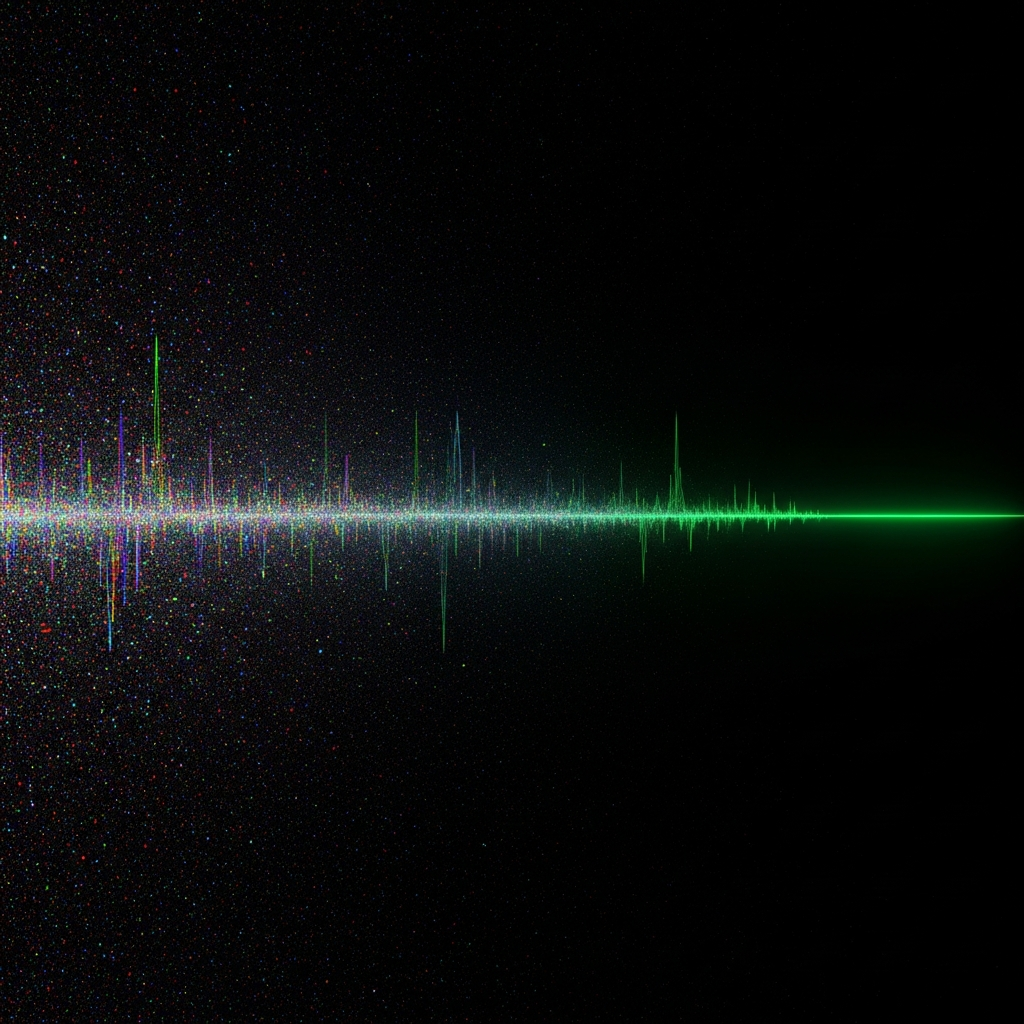
Quantum states are incredibly delicate. A stray photon, a vibration from a passing truck, or a fluctuation in temperature can cause a qubit to lose its memory (decoherence). This is called “noise.”
We need to turn the chaotic noise of physical qubits into the clean signal of logical qubits (Image: Generated by Imagen 3).
To do useful work, we need Logical Qubits—qubits that never make a mistake. To create ONE logical qubit, we might need to gang together 1,000 noisy physical qubits using Quantum Error Correction code. The majority of the computers power is spent just checking itself for errors.
The Real Metric
So when a company says they have a 1,000-qubit processor, ask them: “Are those physical or logical?” Today, we have zero logical qubits. The race isnt just to build more qubits; its to build better ones.
Just as VHS fought Betamax and iOS fights Android, the quantum world is split into two warring factions. On one side, we have the Superconducting Qubits, championed by tech giants like Google and IBM. On the other, Trapped Ions, backed by IonQ and Honeywell.
Team Superconductor (The Golden Chandeliers)
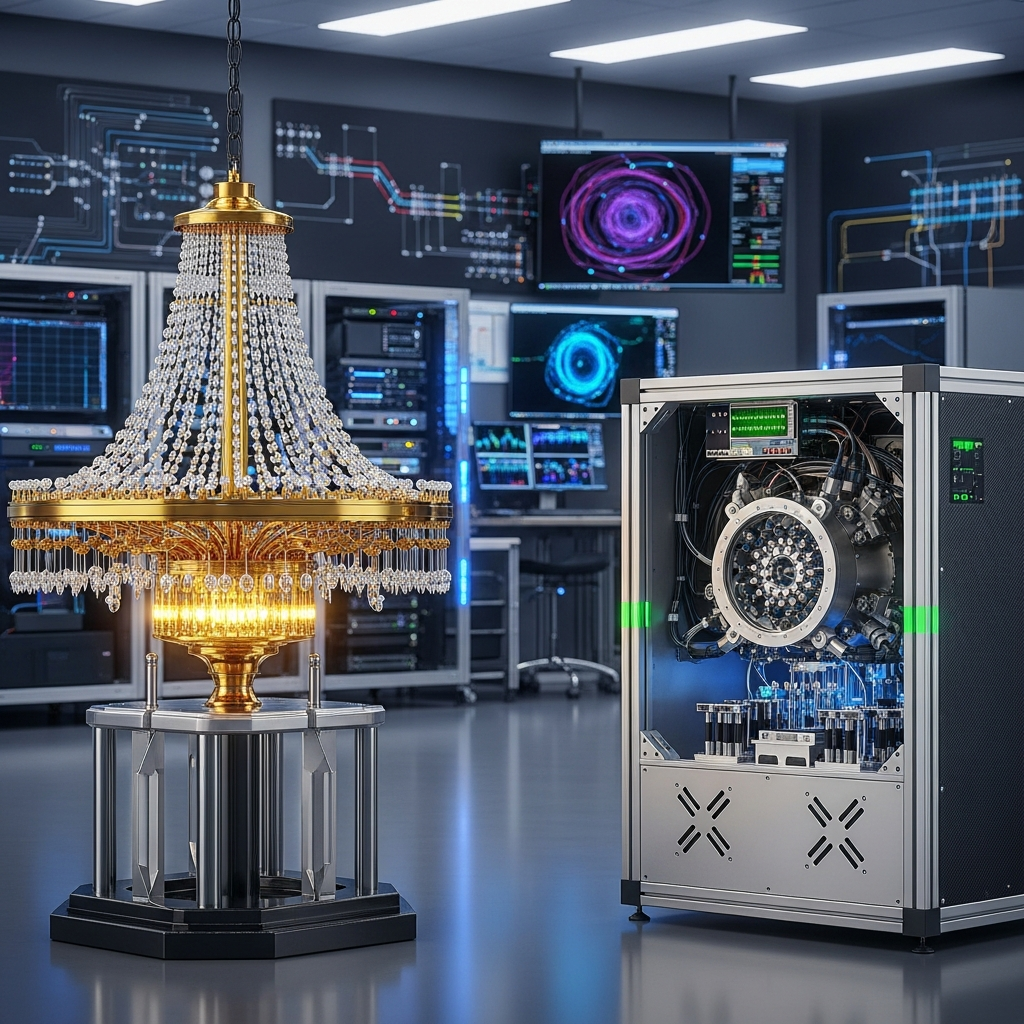
If you have seen a photo of a quantum computer, you have probably seen a golden chandelier. This is a dilution refrigerator that cools the chip down to near absolute zero. These chips are fast—calculations happen in nanoseconds.
Two very different approaches to building the ultimate machine (Image: Generated by Imagen 3).
However, they are fragile. The qubits (made of artificial atoms) interfere with each other easily, leading to errors. They are also hard to wire up as the chip gets bigger.
Team Trapped Ion (The Laser Masters)
IonQ uses a different approach. They take individual atoms (like Ytterbium), levitate them in a vacuum using electromagnetic fields, and hit them with lasers. Because these are natural atoms, they are identical and perfect by nature.
Trapped ions have much lower error rates and better connectivity (every qubit can talk to every other qubit). The downside? They are slow. Operations take microseconds instead of nanoseconds.
Who Wins?
It is too early to call. Superconductors are currently leading in raw qubit count, but Trapped Ions are winning on quality (Quantum Volume). And lurking in the background are dark horses like Photonic (PsiQuantum) and Neutral Atom (QuEra) computers.
There is a paradox at the heart of modern agriculture. To sustain a population of 8 billion people, we rely on a chemical process that is shockingly inefficient. The Haber-Bosch process, invented in the early 20th century to synthesize ammonia for fertilizer, consumes nearly 2% of the world’s entire energy supply.
It requires massive factories, immense pressure, and temperatures of 400 degrees Celsius to rip nitrogen bonds apart. Yet, just beneath our feet, soil bacteria do the exact same thing at room temperature, using no fossil fuels at all.
The FeMoco Mystery
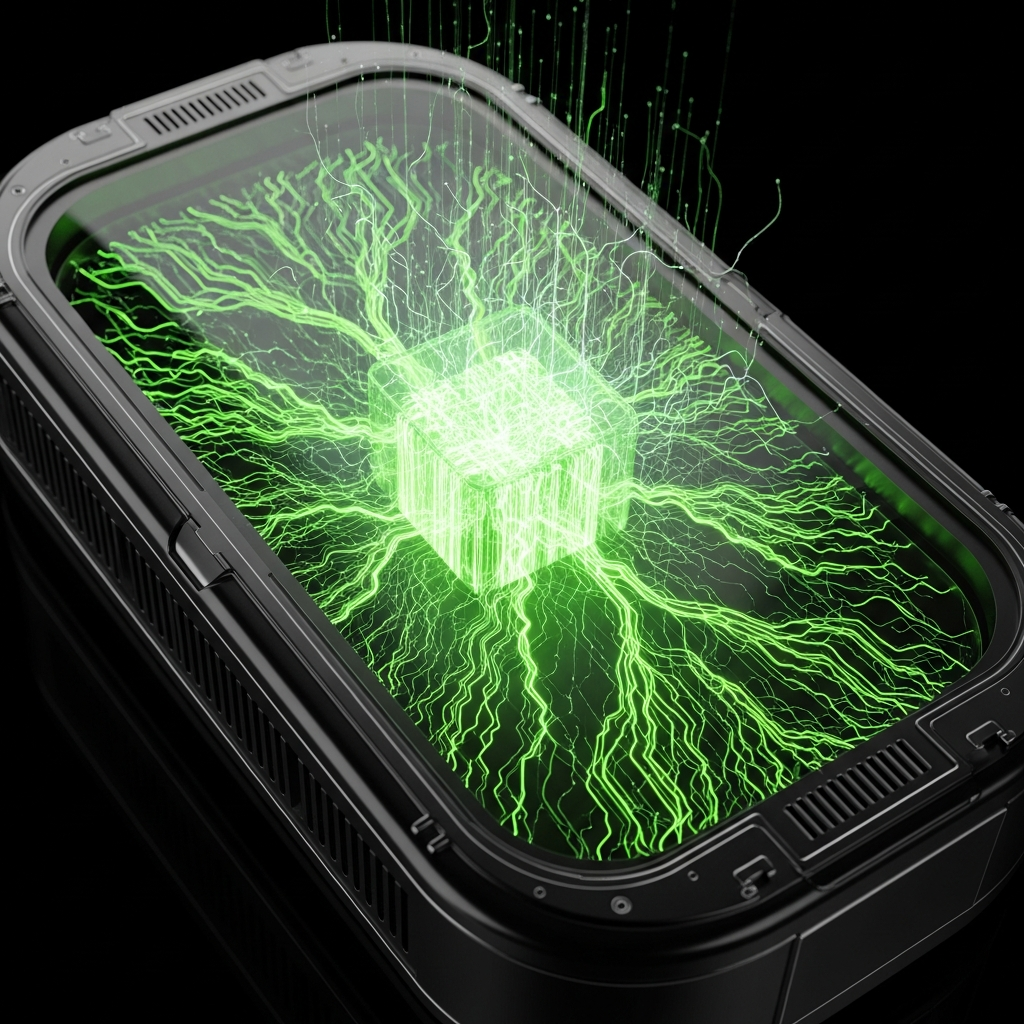
The secret lies in an enzyme called Nitrogenase, and specifically in its catalytic core, a cluster of iron and molybdenum atoms known as FeMoco. For decades, chemists have tried to model this cluster to understand how it works, so we can replicate it industrially.
Modeling Nitrogenase is the “Hello World” of quantum chemistry (Image: Generated by Imagen 3).
They have failed. The electrons in the FeMoco cluster are highly entangled. Their spins interact in ways that cause the “many-body problem” to explode exponentially on a classical computer. Even a supercomputer the size of the earth could not accurately simulate the quantum state of this single molecule.
The Holy Grail of Simulation
This is why Microsoft’s Azure Quantum team has flagged Nitrogenase as a primary target. A quantum computer with just a few hundred logical qubits could map the electron orbitals of FeMoco perfectly.
Solving this puzzle isn’t just about cheaper food. It is about decarbonization. Replacing Haber-Bosch with a bio-mimetic, room-temperature catalyst would slash global carbon emissions more effectively than almost any other single technology. It is a reminder that sometimes, the most advanced technology is simply catching up to what nature figured out billions of years ago.
Imagine charging your Tesla in 3 seconds. Not 30 minutes. Three seconds. Imagine a phone battery that lasts a month. This sounds like vaporware, but according to the laws of quantum mechanics, it is theoretically possible.
The bottleneck of the electric vehicle revolution isn’t the motor or the software; it’s the chemistry. Lithium-ion batteries are heavy, slow to charge, and prone to catching fire. We are hitting the limits of what classical chemistry can achieve.
The Simulation Game
The problem is that we can’t see what’s happening inside a battery at the atomic level. Simulating the interaction of ions moving through an electrolyte is too complex for even the biggest supercomputer.
Quantum simulations could unlock solid-state batteries with 10x energy density (Image: Generated by Imagen 3).
This is the “Killer App” for quantum computers. Companies like Mercedes-Benz and IBM are already partnering to model new materials for solid-state batteries. By simulating the quantum states of molecules, they can discover new electrolytes that offer 10x energy density without ever mixing a chemical in a lab.
Superabsorption: Breaking the Rules
But it gets weirder. Researchers are exploring a quantum phenomenon called Superabsorption. In a classical battery, the more cells you have, the longer it takes to charge. In a quantum battery utilizing entanglement, the opposite happens: the charging speed increases with the size of the battery.
This means a massive grid-scale battery could absorb energy almost instantly. We are years away from a prototype, but the physics suggests that our current charging speeds are just a temporary limitation of our primitive understanding of the universe.
The free money party is over. For the last five years, pitching a “Quantum” startup to a Venture Capitalist was like printing money. It didn’t matter if you had a product. It didn’t matter if your roadmap violated the laws of physics. If you said “Qubit,” you got a check.
Now, the hangover is setting in. Stock prices for public quantum companies like IonQ and Rigetti have seen massive volatility. The timeline for a commercially useful machine—one that can actually do something your MacBook can’t—keeps slipping from 2025 to 2030, and now to 2035.
The Trough of Disillusionment
We are entering what Gartner calls the “Trough of Disillusionment.” It happens to every hype cycle (remember 3D printing?). The early excitement fades as engineering reality hits. And the reality of quantum computing is brutal.
Are investors getting cold feet as technical hurdles mount? (Image: Generated by Imagen 3).
Keeping a qubit stable requires an environment colder than deep space, shielded from the magnetic field of the Earth, and isolated from a single stray photon. Building one is a triumph of physics. Building a million of them, wired together, is an engineering nightmare that we haven’t solved yet.
Survival of the Fittest
This “Winter” isn’t the end; it’s a filter. The companies with weak IP and flashy PowerPoints will die. The capital is consolidating around the serious players who are solving the hard problems—error correction and logical qubits.
We saw the same thing happen to AI in the 1980s. The funding dried up for decades. But the people who kept working in the dark eventually gave us ChatGPT. The Quantum Winter is coming, but for those who can survive the cold, the spring will be revolutionary.
The most significant trade war of the 21st century is not about steel or soybeans. It is about sub-atomic particles. In October 2022, the Bureau of Industry and Security (BIS) released a sweeping set of export controls. While the headlines focused on AI chips preventing China from training the next GPT-4, the fine print contained a lethal blow to Beijing’s quantum ambitions.
The regulations specifically target the enabling hardware of quantum computing: dilution refrigerators that cool chips to near absolute zero, and advanced electronic control systems. This is the first time the US government has explicitly weaponized the supply chain of a technology that technically doesn’t even work yet.
The Q-Day Nightmare Scenario
Why the panic? Because in the eyes of the Pentagon, a fault-tolerant quantum computer is not a research tool; it is a weapon of mass decryption. The nation that reaches “Q-Day” first will possess the skeleton key to the world’s digital infrastructure. They could silently decrypt every intercepted military communication, intelligence cable, and grid schematic harvested over the last two decades.
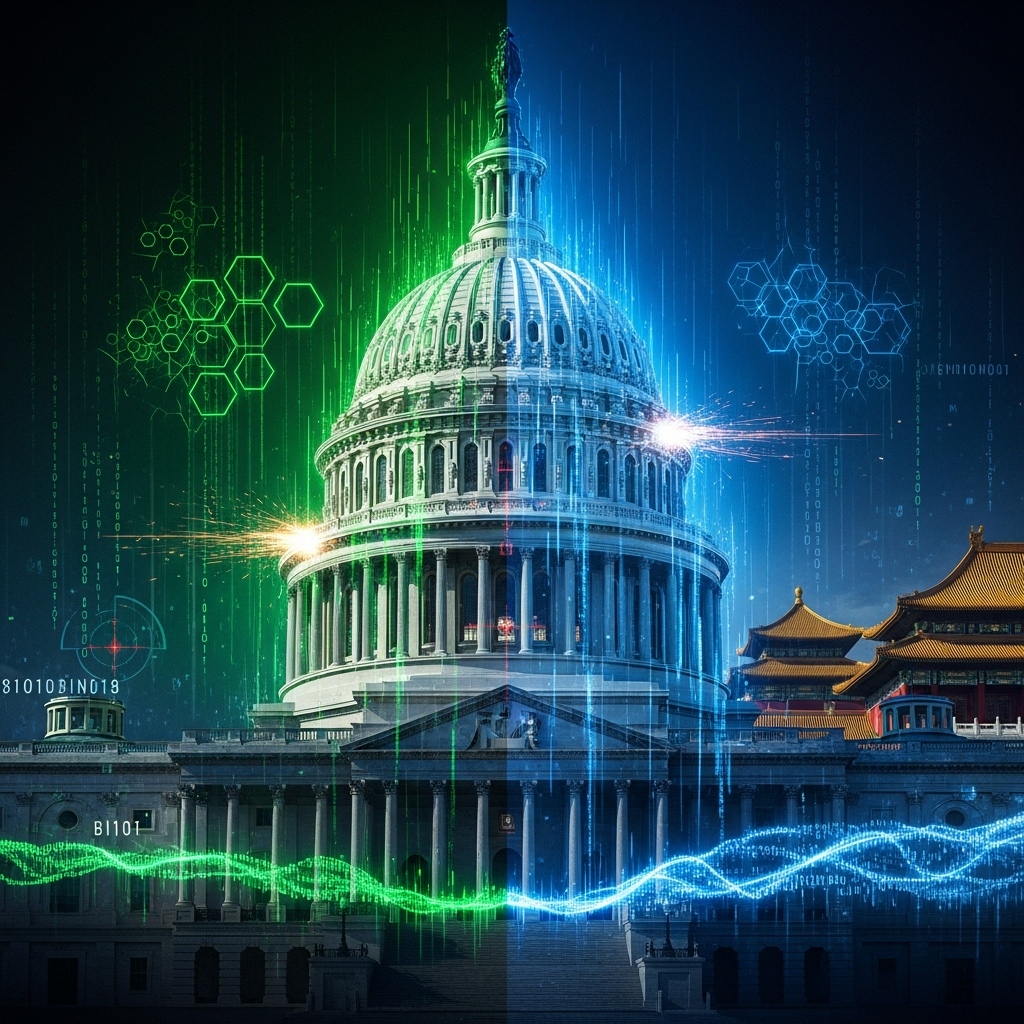
The next arms race isn’t nuclear; it’s computational (Image: Generated by Imagen 3).
Asymmetric Warfare: Computing vs. Communication
Interestingly, the two superpowers are betting on different horses. The US ecosystem (Google, IBM, Rigetti) is heavily focused on Quantum Computing—raw processing power. China, conversely, has poured billions into Quantum Communication.
In 2016, China launched the Micius satellite, which successfully established a Quantum Key Distribution (QKD) link between space and Earth. This technology uses entangled photons to create a communications channel that is physically impossible to wiretap. If an eavesdropper attempts to observe the photons, the quantum state collapses, alerting the sender instantly.
While the US tries to build a sword to break encryption, China is frantically building an unbreakable shield. The export bans are an attempt to freeze China’s sword-making capability while the US catches up on shields.
We are running out of juice. Literally. A single query to ChatGPT consumes nearly 10 times the electricity of a standard Google search. As we race toward GPT-5, GPT-6, and the elusive AGI (Artificial General Intelligence), we are facing a brutal physical reality: Silicon chips generate heat. Too much heat.
We can build bigger data centers, sure. We can pave the desert with solar panels. But eventually, Moore’s Law hits the thermodynamic limit. To make AI 100x smarter, we don’t need just more chips; we need different physics.
Enter the Q-LLM
Imagine a Large Language Model that doesn’t just predict the next word based on statistical probability, but calculates the “semantic meaning” using quantum states. This is the promise of Quantum Natural Language Processing (QNLP).
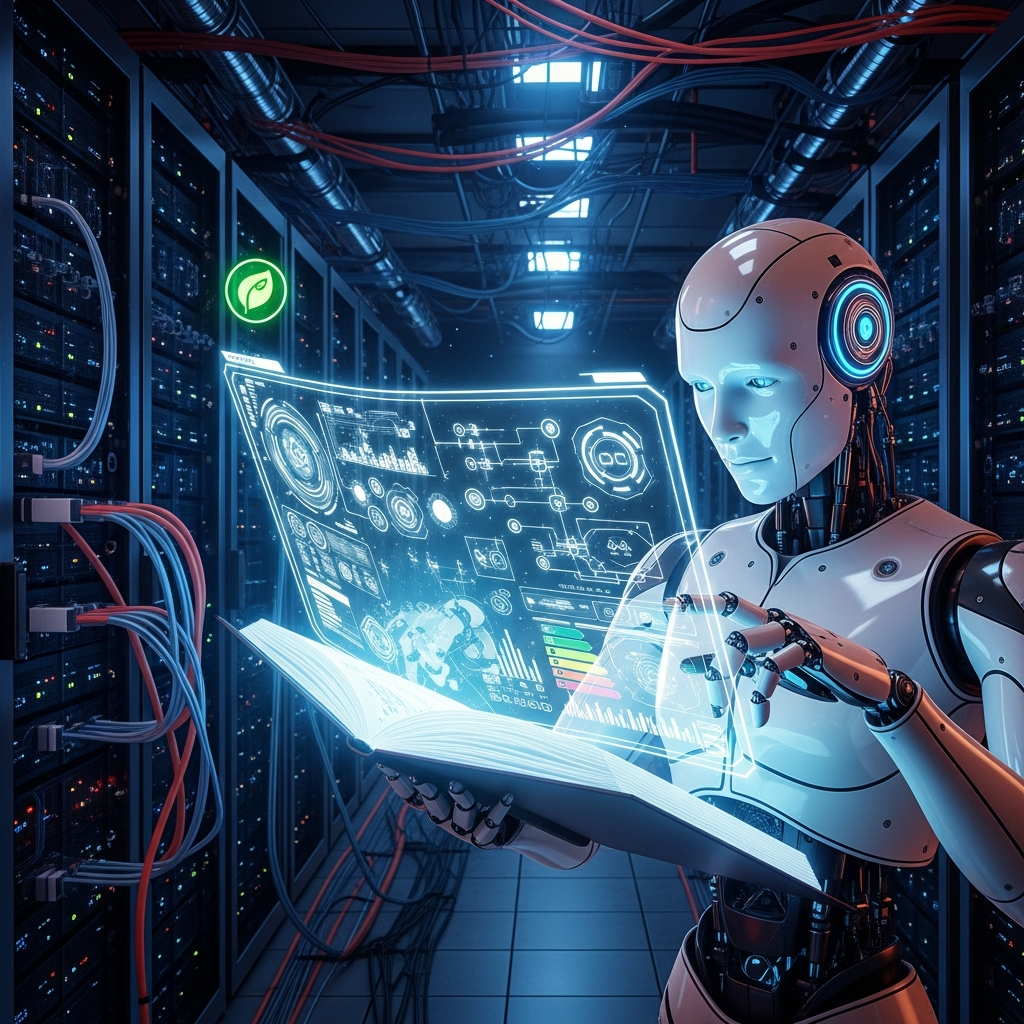
Future LLMs might not just predict the next token; they might calculate the quantum probability of meaning (Image: Generated by Imagen 3).
Researchers at Quantinuum have already run NLP tasks on actual quantum hardware. They successfully mapped the grammatical structure of sentences—subject, verb, object—directly onto quantum circuits. It turns out that language, with its complex entanglements of meaning and context, behaves a lot like quantum mechanics. A word changes its meaning based on the words around it, just as a particle changes its state based on observation.
The Cold Intelligence
The ultimate sci-fi dream is a Reversible Computer. In classical computing, every time a bit flips, it generates heat (information loss). In quantum computing, operations are theoretically reversible. This means a Q-LLM could think without burning the planet down.
We aren’t there yet. We are barely measuring coherence times in milliseconds. But if we ever want an AI that can run simulations of the entire universe, it won’t be running on Nvidia H100s. It will be floating in a vacuum, at near absolute zero, dreaming in qubits.
The dirty secret of modern Artificial Intelligence is that it is hitting a wall. The wall is not data; we have the entire internet. The wall is not architecture; Transformers are highly capable. The wall is optimization.
Training a massive neural network like GPT-4 involves adjusting trillions of parameters to minimize an error function. Mathematically, this is an optimization problem played out on a non-convex landscape with billions of dimensions. Classical computers, using Gradient Descent, navigate this landscape like a hiker in a thick fog, feeling their way down the slope one step at a time. They frequently get stuck in “local minima”—valleys that look like the bottom but aren’t.
The Tunneling Advantage
Quantum Machine Learning (QML) proposes a radical shift in how we train models. Quantum computers can exploit quantum tunneling to simply pass through the barriers that trap classical algorithms. Instead of climbing over a hill to find a deeper valley, a quantum optimizer can tunnel through it.
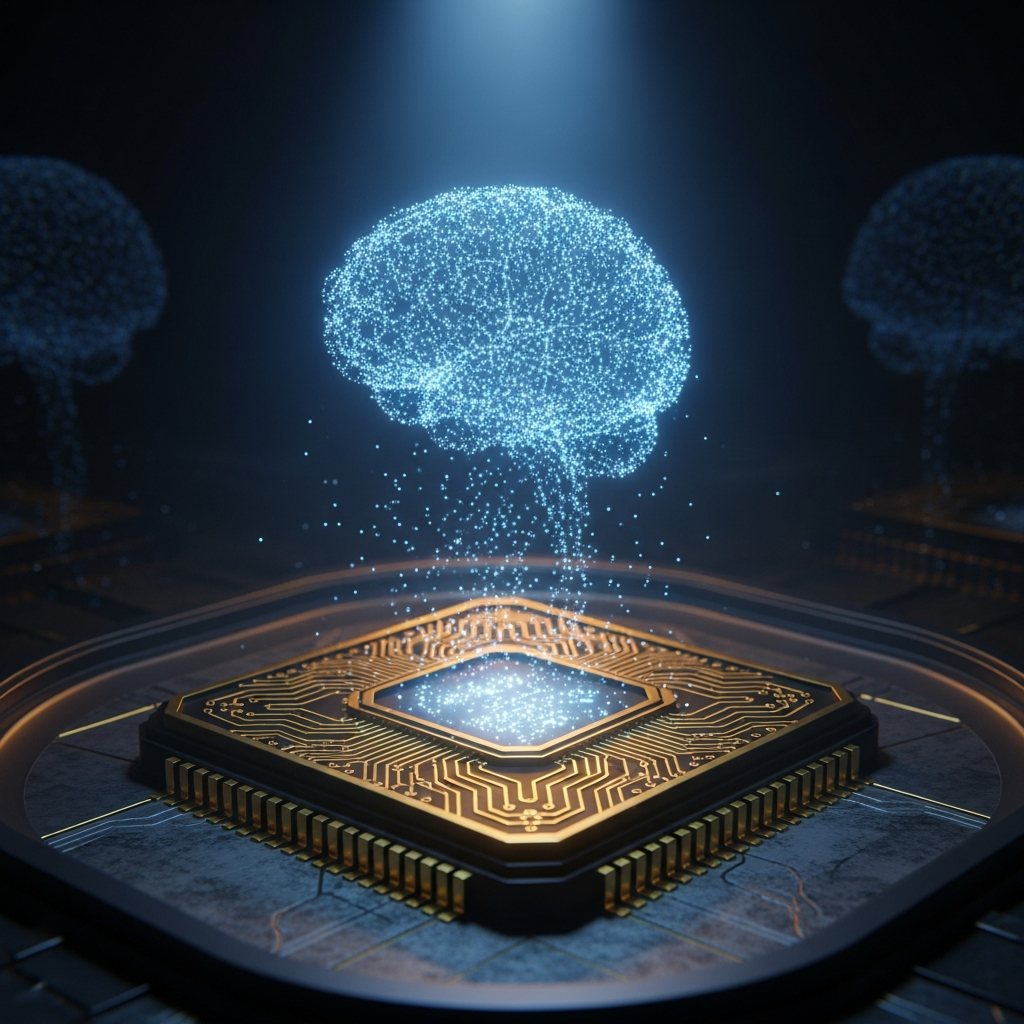
The fusion of biological-inspired AI and quantum hardware creates a new kind of intelligence (Image: Generated by Imagen 3).
Researchers at IBM and Google are exploring Quantum Neural Networks (QNNs). These are hybrid algorithms where a classical computer handles the heavy lifting of data processing, but the difficult kernel functions—the mathematical heart of pattern recognition—are offloaded to a Quantum Processing Unit (QPU).
Linear Algebra at Warp Speed
Deep learning is, at its core, linear algebra. It is matrix multiplication at a massive scale. The HHL algorithm (Harrow-Hassidim-Lloyd), proposed in 2009, demonstrated that quantum computers could solve systems of linear equations exponentially faster than classical machines.
While current “Noisy Intermediate-Scale Quantum” (NISQ) devices are too error-prone to run HHL at scale, the roadmap is clear. As error correction improves, QML could reduce the training time of foundational models from months to hours. This would not only democratize AI development but also drastically reduce the carbon footprint of the industry, which currently rivals the aviation sector.
In a deterministic universe, randomness is an illusion. If you knew the position and velocity of every particle in the cosmos at the moment of the Big Bang, and you had infinite computational power, you could theoretically calculate the exact moment you would read this sentence. This was the view of Pierre-Simon Laplace, and for centuries, classical physics agreed.
Computers, the ultimate engines of determinism, cannot generate true randomness. When a standard server generates a cryptographic key, it uses a Pseudo-Random Number Generator (PRNG). It takes a “seed”—perhaps the current time in milliseconds—and runs it through a chaotic algorithm. The result looks random to a human, but to a sufficiently motivated adversary who knows the seed, it is as predictable as a sunrise.
The Collapse of Determinism
Quantum mechanics shattered this comfortable clockwork reality. When a photon hits a beam splitter, it has a 50% probability of passing through and a 50% probability of reflecting. Until it is measured, it does both. When it is measured, the outcome is not determined by any hidden variable or previous state. It is intrinsic, fundamental randomness. It is the only thing in the universe that cannot be predicted, even in principle.
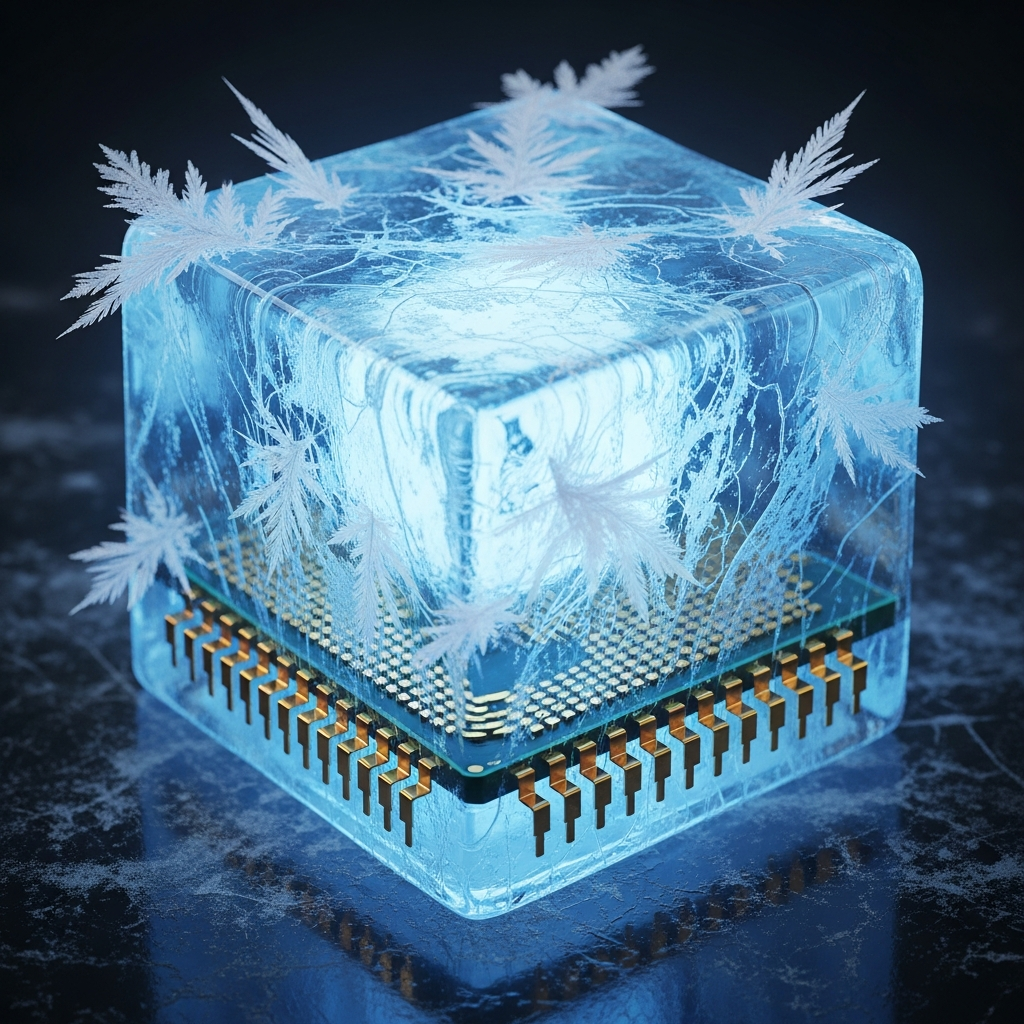
Visualizing the unpredictable nature of quantum states (Image: Generated by Imagen 3).
This property has moved from philosophical debates to silicon chips. Quantum Random Number Generators (QRNG) harness the collapse of the wave function to generate entropy. Unlike the “Lava Lamps” used by Cloudflare—which are a clever but classical macroscopic solution—QRNG chips measure the quantum noise of light (vacuum fluctuations) or the path of single photons.
Securing the Post-Quantum World
The implications for cryptography are profound. A cryptographic key is only as strong as its randomness. If a hacker can predict the random number generator, the encryption is worthless.
Companies like ID Quantique have successfully miniaturized this technology. The Samsung Galaxy Quantum smartphone series already contains a QRNG chip measuring 2.5mm square. It ensures that the encryption keys generated for banking apps are derived from the fundamental uncertainty of nature itself. Einstein famously objected to quantum mechanics by saying, “God does not play dice.” The existence of the QRNG industry suggests that not only does He play dice, but He is the only one who can roll them fairly.