Blog

  • The Death of RSA: How Shor’s Algorithm Breaks the Internet

    Technical Deep Dive — For nearly four decades, the Rivest–Shamir–Adleman (RSA) cryptosystem has stood as the sentinel of the digital age. Published in 1977, it relies on a computational asymmetry so profound it was believed to be practically unbreakable: the difficulty of factoring the product of two large prime numbers.

    To understand the magnitude of the threat facing RSA, one must first appreciate the scale of the problem classical computers face. Factoring a 2048-bit integer—the current gold standard for SSL/TLS certificates—would take a classical supercomputer roughly 300 trillion years. It is a problem of “exponential complexity.”

    However, in 1994, mathematician Peter Shor introduced a quantum algorithm that reduced this complexity class from exponential to polynomial. This wasn’t just an optimization; it was a theoretical sledgehammer that transformed the impossible into the trivial.

    The Mechanics of Collapse: Understanding Shor’s Algorithm

    Shor’s algorithm utilizes two unique quantum properties: superposition and quantum interference. In a classical search for prime factors, you try numbers sequentially. In a quantum system, you can construct a superposition of all possible states.
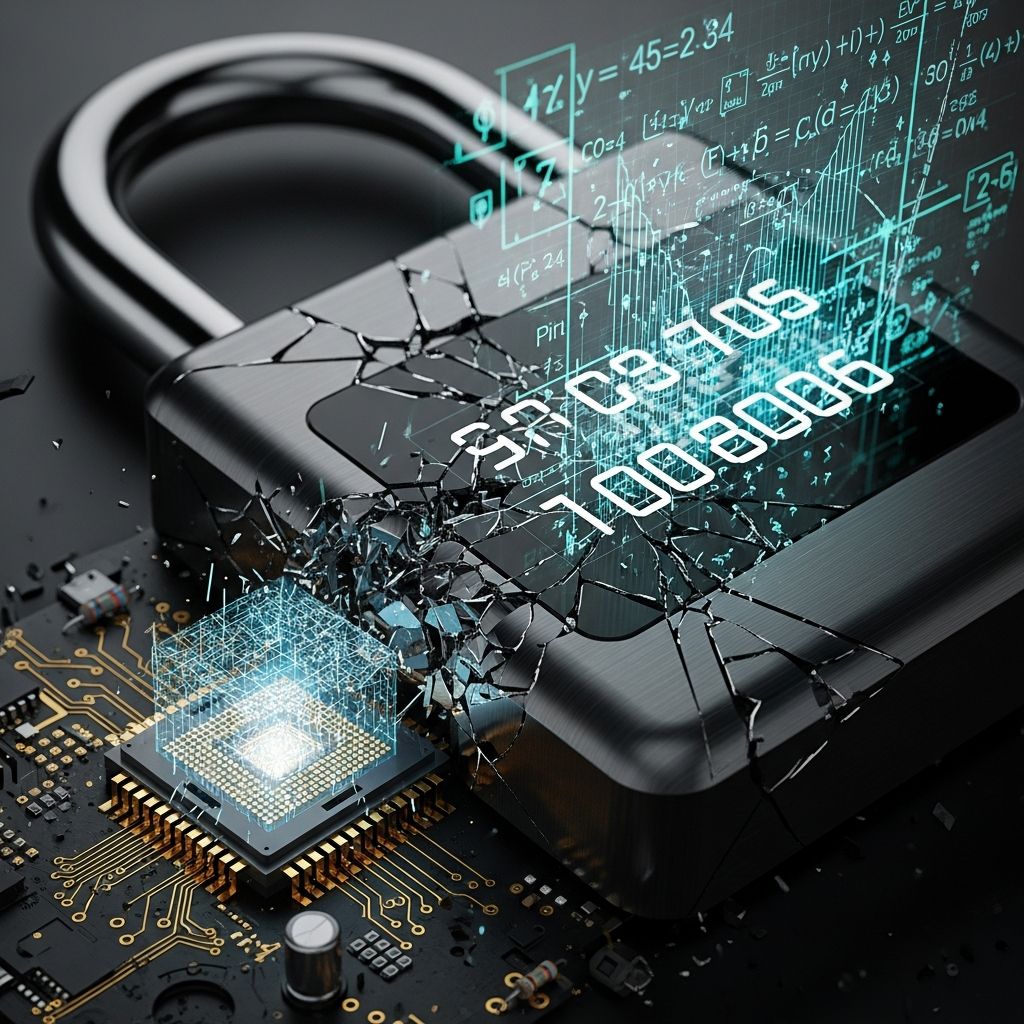
    Broken padlock AI generated
    The fragility of prime factorization exposed by quantum period finding (Image: Generated by Imagen 3).

    Shor discovered that the prime factorization problem could be mapped to a problem of finding the period of a specific modular function. By applying a Quantum Fourier Transform (QFT), the algorithm causes incorrect answers to destructively interfere (cancel each other out) and the correct period to constructively interfere (amplify).

    The result is that a CRQC (Cryptographically Relevant Quantum Computer) with approximately 4,099 stable logical qubits could factor an RSA-2048 key in roughly 10 seconds. For context, IBM’s current “Osprey” processor boasts 433 physical qubits, which are far too noisy to be logical qubits. We are still orders of magnitude away from the hardware requirement, but the software path is clear.

    The Industry Response: NIST and Lattice-Based Cryptography

    The impending deprecation of RSA has triggered a global standardization effort led by NIST. The selected replacement algorithms rely on entirely different mathematical problems that are believed to be quantum-hard.

    The most promising of these is Lattice-based cryptography. Instead of factoring numbers, these algorithms involve finding the shortest vector in a high-dimensional lattice grid. This geometric problem remains computationally intensive even for a quantum computer running Shor’s or Grover’s algorithms.

    The transition, however, is fraught with technical peril. Lattice-based keys are significantly larger than RSA keys (measured in kilobytes rather than bits), introducing latency penalties in TLS handshakes. For embedded systems and IoT devices with limited memory, the death of RSA presents a hardware resource crisis that the industry is only beginning to address.
  • Ethereum vs. Quantum: The Great Upgrade

    There is a nightmare scenario for crypto that nobody likes to talk about. It’s 2035. You wake up, check your MetaMask wallet, and see zero ETH. You didn’t click a phishing link. You didn’t leak your seed phrase. You did nothing wrong. The blockchain itself was broken.

    This is the existential threat of Quantum Computing to cryptocurrency. And while Bitcoin is taking a “wait and see” approach, Ethereum is actively architecting its survival strategy. The plan is bold, technical, and potentially messy. Here is how the world’s computer plans to survive the physics apocalypse.

    The Vulnerability: Why Your Keys Are Weak

    First, the bad news. Ethereum, like almost everything else, uses Elliptic Curve Cryptography (specifically secp256k1) to generate the public-private key pairs that own your funds. A quantum computer running Shor’s Algorithm can reverse-engineer your private key just by looking at your public key.

    If you have ever sent a transaction from your wallet, your public key is exposed on-chain. That means you are a target.

    Ethereum coin AI generated
    Ethereum’s transition to quantum resistance will be the biggest upgrade in its history (Image: Generated by Imagen 3).

    Plan A: The Emergency Eject Button

    Vitalik Buterin has already written the playbook for what happens if a quantum computer appears by surprise. It’s essentially a “break glass in case of emergency” hard fork.

    In this scenario, the Ethereum network would effectively freeze. The developers would roll back the chain to a point before the thefts began. But here is the kicker: to get your money back, you would have to prove you own it using a new type of math. Users would need to sign a transaction using STARKs (Zero-Knowledge proofs) or Winternitz one-time signatures.

    These algorithms are “quantum-resistant” by design. It would be a chaotic few weeks, and gas fees would likely hit astronomical levels, but the network would survive. It’s not elegant, but it stops the bleeding.

    Plan B: Account Abstraction (The Real Fix)

    The long-term fix is much cooler. It’s called Account Abstraction (ERC-4337), and it’s already live.

    Right now, your Ethereum account is dumb. It’s just a key pair. Account Abstraction turns your wallet into a smart contract. This means the “logic” of how you sign a transaction is programmable. Today, you can program it to use the old, vulnerable ECDSA signature. But tomorrow? You can simply push an update to your wallet that swaps out the lock for a quantum-safe algorithm like FALCON or SPHINCS+.

    This decouples your asset security from the underlying math of the blockchain. It’s the ultimate future-proofing. While Bitcoiners might have to fight a civil war to upgrade their protocol via a soft fork, Ethereans might just need to download a wallet update.

  • Harvest Now, Decrypt Later: Why Your Data is Already at Risk

    It starts as a whisper in the data centers of Langley and Beijing. Not a siren, not a crash, but a silent accumulation. For the last decade, intelligence agencies across the globe have been playing the longest game in the history of espionage. They are hoarding everything. Every encrypted email, every diplomatic cable, every blueprint for a next-gen fighter jet that flows through the fiber optic cables of the internet.

    They can’t read a word of it. Yet.

    This strategy is known in the trade as Harvest Now, Decrypt Later (HNDL). It is a gamble of astronomical proportions—a bet that within ten to fifteen years, a machine will come online that shatters the mathematical shield protecting our digital reality. That machine is the Cryptographically Relevant Quantum Computer (CRQC).

    The Time Capsule of Doom

    Imagine burying a time capsule in your backyard. Inside, you put your deepest secrets, locked in a titanium safe. You assume it’s safe because no drill existing today can penetrate it. But HNDL is like a neighbor who steals the safe and puts it in their basement, patiently waiting for the invention of the laser cutter.

    Cyber security lock screen generated by AI
    Data centers around the world are silently storing encrypted traffic, waiting for Q-Day (Image: Generated by Imagen 3).

    The encryption protecting your bank account and your Signal messages—RSA, Elliptic Curve—relies on integer factorization. It works because classical computers are terrible at factoring huge numbers. A supercomputer might take trillion years to crack a 2048-bit key. But Peter Shor, a mathematician at Bell Labs, proved in 1994 that a quantum computer could do it in hours. The only thing missing was the hardware. Now, with IBM and Google racing past the 1,000-qubit mark, the hardware is catching up to the math.

    Mosca’s Inequality: The Math of Panic

    Michele Mosca, a quantum computing pioneer, laid out the timeline of this catastrophe in a simple inequality that keeps CISOs awake at night. It looks like this: X + Y > Z.

    • X is the “shelf life” of your secrets. How long must a genomic database or a nuclear launch code remain secret? For many, it’s 25 to 50 years.
    • Y is the migration time. How long will it take to update every server, satellite, and ATM in the world to new, quantum-safe encryption? History suggests this takes decades.
    • Z is the “Collapse Time.” The moment a functional quantum computer comes online.

    If the time your secrets need to last plus the time it takes to re-tool is longer than the time until Q-Day, you have already lost. The data stolen today will be readable before it becomes irrelevant.

    The Post-Quantum Race

    This isn’t just paranoia. It is policy. The NIST (National Institute of Standards and Technology) has been running a frantic, Survivor-style competition to find new algorithms that can withstand a quantum attack. They recently crowned four winners, including CRYSTALS-Kyber for general encryption.

    But implementing them is a nightmare. Unlike a simple software update, switching to Post-Quantum Cryptography (PQC) often requires more processing power and larger key sizes. It breaks older devices. It slows down networks. And while we struggle with the upgrade, the servers in the basement keep humming, recording every byte, waiting for the day the lock breaks.

  • The Quantum Market: Why Wall Street Is Obsessed with Qubits

    While physicists dream of understanding the universe, Wall Street dreams of beating the market. Financial institutions like Goldman Sachs and JPMorgan Chase are among the most aggressive early adopters of quantum technology.

    Optimization on Steroids

    Finance is essentially a giant optimization problem. How do you balance a portfolio of thousands of assets to maximize return while minimizing risk? This is known as the "Knapsack Problem" in computer science, and it becomes exponentially harder with every new asset added.

    Quantum algorithms like QAOA (Quantum Approximate Optimization Algorithm) can scan through vast landscapes of possibilities to find the absolute optimal solution in seconds, something that would take a supercomputer days.

    Turbocharged Monte Carlo

    Banks run Monte Carlo simulations to predict the pricing of options and evaluate risk. These simulations run millions of random scenarios to average out a result. Quantum computers can perform these calculations with a quadratic speedup, allowing banks to price complex derivatives in real-time, reacting to market crashes before they even fully happen.

  • Pharma 2.0: How Quantum Computing Will Cure the Incurable

    Developing a new drug today is a gamble. It takes over a decade, costs billions of dollars, and has a 90% failure rate. The bottleneck? Our inability to accurately simulate molecular interactions on classical computers.

    Feynman’s Vision

    In 1981, physicist Richard Feynman famously said, "Nature isnt classical, dammit, and if you want to make a simulation of nature, youd better make it quantum mechanical." Forty years later, we are finally listening.

    Molecules are quantum systems. To simulate a simple caffeine molecule perfectly on a classical computer would require more bits than there are atoms in the universe. A quantum computer, however, uses qubits which can exist in multiple states at once, allowing it to map these complex interactions naturally.

    The End of Trial and Error

    With quantum simulation, pharmaceutical giants can move from "discovery by accident" to "discovery by design." They can model how a potential drug binds to a protein target with 100% accuracy before synthesizing a single gram in the lab.

    This could unlock cures for Alzheimers, new antibiotics for superbugs, and personalized cancer treatments tailored to a patients specific genetic mutation.

  • The Quantum Threat to Crypto: Is Bitcoin Doomed?

    In the shadowy corners of the internet and the bright labs of tech giants like IBM and Google, a storm is brewing. It’s not a new hacker collective or a regulatory crackdown. It’s physics. Specifically, Quantum Computing.

    The ECDSA Vulnerability

    Most modern cryptocurrencies, including Bitcoin and Ethereum, rely on a cryptographic scheme called Elliptic Curve Digital Signature Algorithm (ECDSA). This math is what ensures that only you can spend your coins. It relies on the fact that while its easy to multiply two large prime numbers together, it is practically impossible for a classic computer to reverse that process and find the original factors.

    Enter Shor’s Algorithm. Theoretical mathematician Peter Shor proved that a sufficiently powerful quantum computer could factor these massive numbers exponentially faster than any supercomputer existing today. If a quantum computer can derive your private key from your public address, the security model of Bitcoin collapses instantly.

    When is Q-Day?

    Experts refer to the day a quantum computer breaks current encryption as Q-Day. Estimates vary wildly. Optimists (or pessimists, depending on your bag) say we are 5-10 years away. Skeptics argue the error-correction required for stable qubits (the quantum version of bits) is decades off.

    The Defense: Post-Quantum Cryptography

    It’s not all doom and gloom. The crypto community is already preparing. Post-Quantum Cryptography (PQC) involves algorithms based on mathematical problems that even quantum computers find hard, such as lattice-based cryptography.

    Bitcoin and other chains can soft-fork to include these new signature schemes. The challenge will be migrating old lost wallets that havent moved funds in years. Those might become vulnerable honey-pots for quantum hackers.

    Conclusion

    Quantum computing represents a massive paradigm shift, but it is an arms race. As the sword gets sharper, the shield gets stronger. The future of crypto isnt dead; its just going to get a lot more complex.