The dirty secret of modern Artificial Intelligence is that it is hitting a wall. The wall is not data; we have the entire internet. The wall is not architecture; Transformers are highly capable. The wall is optimization.
Training a massive neural network like GPT-4 involves adjusting trillions of parameters to minimize an error function. Mathematically, this is an optimization problem played out on a non-convex landscape with billions of dimensions. Classical computers, using Gradient Descent, navigate this landscape like a hiker in a thick fog, feeling their way down the slope one step at a time. They frequently get stuck in “local minima”—valleys that look like the bottom but aren’t.
The Tunneling Advantage
Quantum Machine Learning (QML) proposes a radical shift in how we train models. Quantum computers can exploit quantum tunneling to simply pass through the barriers that trap classical algorithms. Instead of climbing over a hill to find a deeper valley, a quantum optimizer can tunnel through it.
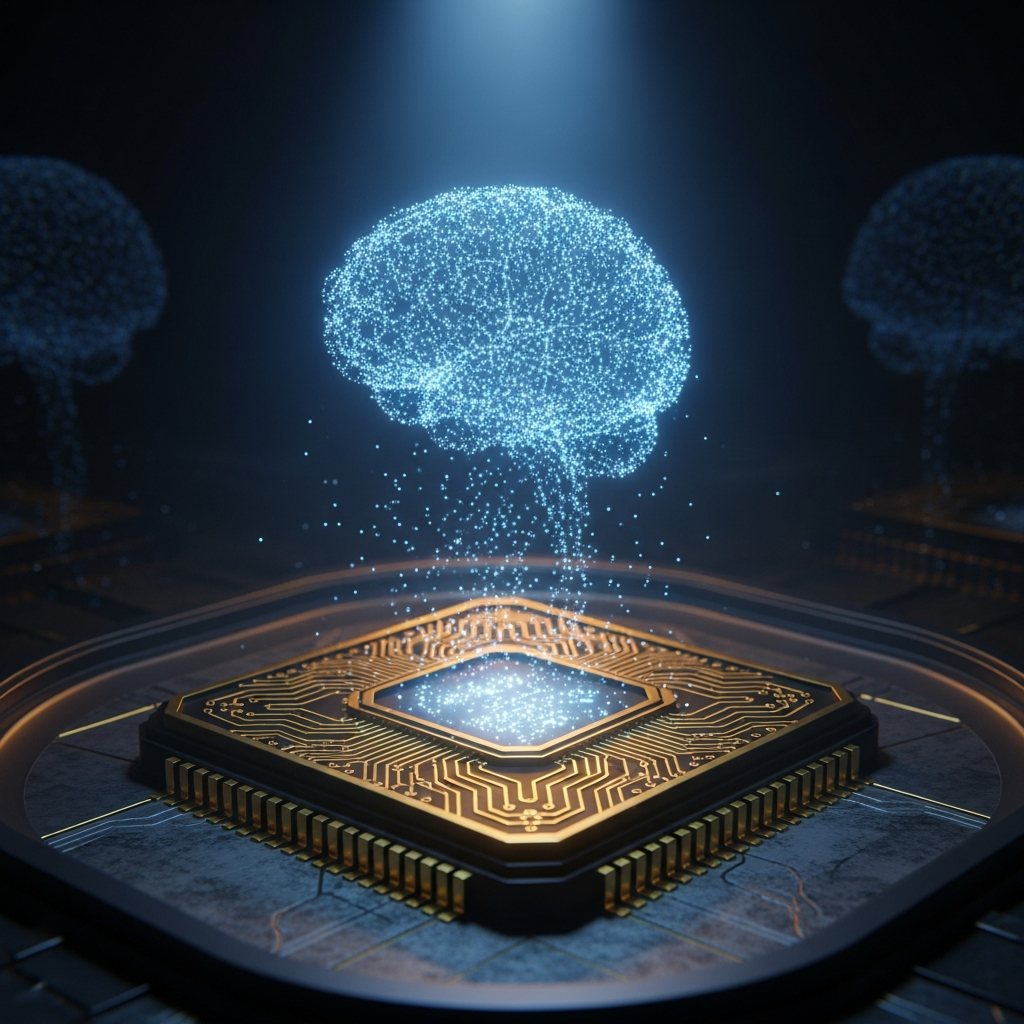
Researchers at IBM and Google are exploring Quantum Neural Networks (QNNs). These are hybrid algorithms where a classical computer handles the heavy lifting of data processing, but the difficult kernel functions—the mathematical heart of pattern recognition—are offloaded to a Quantum Processing Unit (QPU).
Linear Algebra at Warp Speed
Deep learning is, at its core, linear algebra. It is matrix multiplication at a massive scale. The HHL algorithm (Harrow-Hassidim-Lloyd), proposed in 2009, demonstrated that quantum computers could solve systems of linear equations exponentially faster than classical machines.
While current “Noisy Intermediate-Scale Quantum” (NISQ) devices are too error-prone to run HHL at scale, the roadmap is clear. As error correction improves, QML could reduce the training time of foundational models from months to hours. This would not only democratize AI development but also drastically reduce the carbon footprint of the industry, which currently rivals the aviation sector.
Leave a Reply