Just as VHS fought Betamax and iOS fights Android, the quantum world is split into two warring factions. On one side, we have the Superconducting Qubits, championed by tech giants like Google and IBM. On the other, Trapped Ions, backed by IonQ and Honeywell.
Team Superconductor (The Golden Chandeliers)
If you have seen a photo of a quantum computer, you have probably seen a golden chandelier. This is a dilution refrigerator that cools the chip down to near absolute zero. These chips are fast—calculations happen in nanoseconds.
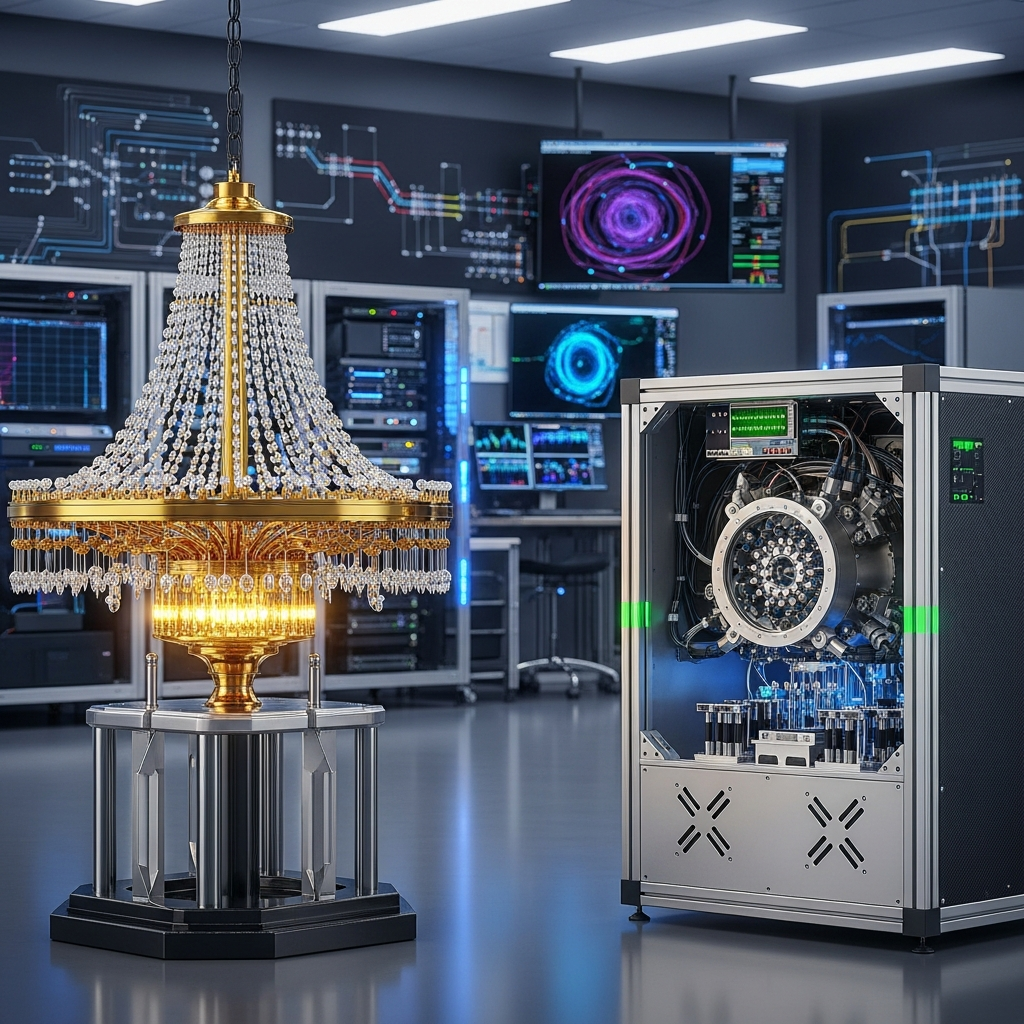
However, they are fragile. The qubits (made of artificial atoms) interfere with each other easily, leading to errors. They are also hard to wire up as the chip gets bigger.
Team Trapped Ion (The Laser Masters)
IonQ uses a different approach. They take individual atoms (like Ytterbium), levitate them in a vacuum using electromagnetic fields, and hit them with lasers. Because these are natural atoms, they are identical and perfect by nature.
Trapped ions have much lower error rates and better connectivity (every qubit can talk to every other qubit). The downside? They are slow. Operations take microseconds instead of nanoseconds.
Who Wins?
It is too early to call. Superconductors are currently leading in raw qubit count, but Trapped Ions are winning on quality (Quantum Volume). And lurking in the background are dark horses like Photonic (PsiQuantum) and Neutral Atom (QuEra) computers.
Sources: IonQ Technology, Google Quantum AI.
Leave a Reply